Skip to content
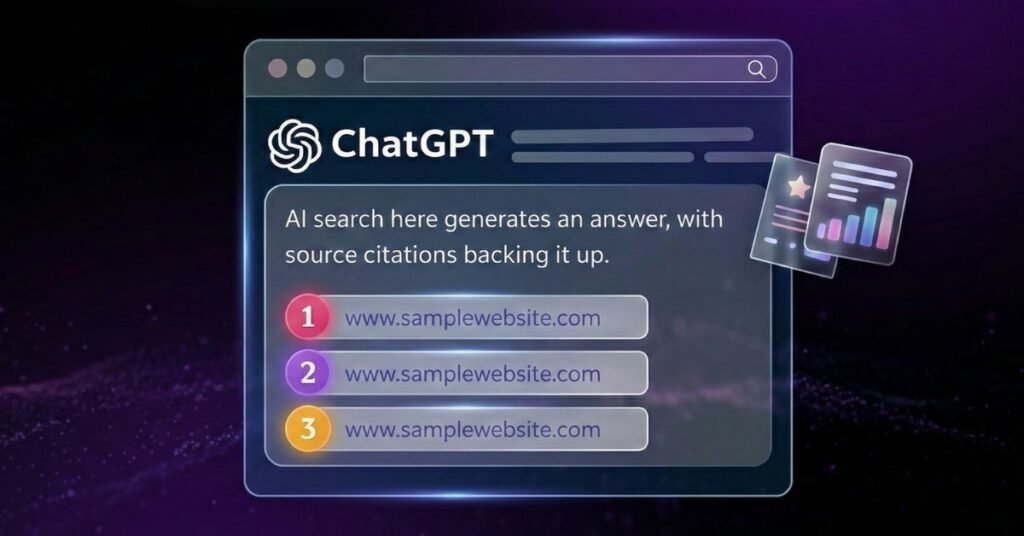
Most businesses tracking their search presence are watching rankings and organic traffic. But a growing share of online searches now end with an AI-generated answer rather than a list of links. ChatGPT citations are how that system credits the content it draws from.
When your content gets cited, your brand appears in the answer. When it does not, your business does not appear in that answer at all, even if your website ranks well in traditional search. DigiEvolve helps businesses show up in both places by optimizing content for SEO citations and AI search visibility.
Highlights:
- AI search visibility drives brand presence
- Front-loaded content earns more citations
- Clear definitions increase citation likelihood
- Specific entities improve AI retrieval
- Structured Q&A format boosts visibility
What ChatGPT Citations Are and Why They Matter
When ChatGPT or a similar AI tool generates a response, it pulls information from sources across the web and often references those sources in the answer. A ChatGPT citation is the credit that AI gives to a specific piece of content it uses when building a response.
This matters because AI Search is now part of how customers find information. A person researching a service or an industry question may get their answer directly from an AI without visiting any website.
The business whose content gets cited appears in that answer. The one whose content does not get cited does not appear at all, no matter how strong its SEO citations or domain authority might be.
Where in Your Content ChatGPT Tends to Pull From
Research analyzing over one million AI-generated responses found that ChatGPT citations are not evenly distributed across a piece of content. The source material that gets pulled tends to come from specific positions within an article or page.
Roughly 44 percent of all ChatGPT citations came from the first third of the content. About 31 percent came from the middle section. The final third produced less than 25 percent of citations, with a notable drop near the footer.
At the paragraph level, the middle of each paragraph generated more than half of all citations. Opening and closing sentences each accounted for roughly a quarter.
AI does not read content the way a human reader would. It prioritizes the early part of a page because that is where context and definitions tend to appear.
Content that buries its most useful points at the end is less likely to produce ChatGPT citations, even if that information is accurate and well-written.
What this means practically is that the structure most businesses use, warming up the reader and saving the main point for later, works against AI retrieval. If your most useful sentence is in paragraph eight, AI may never reach it with enough weight to use it.
Moving your strongest statements to the top of each section changes how often AI pulls from your content. Front-loading is not a style choice in this context. It is what determines whether ChatGPT citations come from your page or someone else’s.
What Makes Content More Likely to Get Cited
The same research identified five consistent characteristics that appeared in content generating the most ChatGPT citations. Understanding these helps content teams write with AI Search in mind without abandoning what works for readers.
Clear Definitions and Direct Statements
Content that used explicit definitions, things like “X is” or “X refers to,” was nearly twice as likely to be cited compared to content with vague or indirect framing.
AI looks for passages where a subject is clearly identified and explained. Writing that takes a long time to get to the point performs worse than writing that states something clearly from the start.
Question-and-Answer Structure
Cited content was about twice as likely to include question marks. Nearly 80 percent of the citations tied to questions came from headings.
AI systems appear to treat H2 and H3 headings as questions and the paragraph below as the answer. Structuring content so each heading poses a question and the text underneath answers it increases the chance of appearing in AI search responses.
This also means the first sentence after a heading carries more weight than sentences further down in that same section. If the opening sentence directly answers what the heading asked, the whole section becomes more useful to AI.
If it delays the answer with background context first, AI may skip that section in favor of a page that answers the question faster.
Named Entities and Specific References
Standard written content typically includes five to eight percent proper nouns. Content with the highest rate of ChatGPT citations averaged over 20 percent.
Specific names, tools, organizations, and places give AI more to work with when it builds a response. Content with few named references gives the system less to use and gets passed over for something more specific.
In practice this means replacing phrases like “many platforms” with actual platform names, citing studies by the organization that ran them, and mentioning specific tools when you are explaining how something works. Generic writing that avoids specifics tends to perform poorly in AI retrieval because it gives AI nothing concrete to use when building an answer.
Increasing entity density is one of the most direct ways to improve your rate of ChatGPT citations.
A Measured, Analytical Tone
Content that scored around the midpoint on a subjectivity scale produced more ChatGPT citations than either purely factual writing or heavily opinionated content. The tone that performed best was grounded in data but included some interpretation alongside it.
This matters for the importance of citation in GEO because tone affects whether AI treats content as a source worth using. Dry recitation of facts and strong opinion pieces both produced fewer citations.
Plain Writing at a Readable Level
Cited content scored at around a grade 16 reading level. Content that did not perform as well averaged closer to grade 19. Shorter sentences and cleaner structure outperformed long, complex prose.
This does not mean oversimplifying. It means getting to the point without unnecessarily wasting time. For businesses accustomed to producing dense long-form content, this is a shift worth building into the content planning process.
Grade 16 writing uses shorter sentences, common words, and one idea per sentence. Grade 19 writing tends to stack multiple clauses, use technical language without explanation, and assume the reader already has context. AI retrieves the former more often because it is faster to process and easier to extract a clean answer from.
Simplifying sentence structure is a low-effort change that can meaningfully improve how often ChatGPT citations come from your pages.
How ChatGPT Citations Differ From SEO Citations
SEO citations typically refer to mentions of a business name, address, or details across directories and external sites. They build local authority and support traditional rankings. ChatGPT citations are different. They are about whether the actual text of your content gets pulled and referenced in AI-generated answers.
Both matter, but they require different approaches. Building SEO citations involves directory management and external mentions. Getting ChatGPT citations requires writing content that AI can extract and use when generating answers.
The importance of citation in GEO is that it determines whether your business appears in AI-generated responses, not just on search engine results pages. A business can have strong SEO citations and still be absent from AI answers if its content is not structured in a way AI can use.
How DigiEvolve Helps Businesses Get Cited in AI Answers
We works with businesses on content strategy that addresses both traditional SEO citations and visibility in AI search. The starting point is identifying where current content falls short of what AI systems look for, which usually comes down to structure, specificity, and where key information is placed on the page.
From there, content gets reworked so the most useful information appears early, definitions are written clearly, headings are framed to match how AI reads them, and named references are added where they belong. This is not about writing for AI at the expense of readers. Content that is clear, specific, and well-organized tends to perform better with both.
ChatGPT citations are not random. They follow clear patterns that content teams can plan for. DigiEvolve helps businesses understand those patterns and produce content that has a stronger chance of being referenced when customers use AI search to find answers.
If your content is not showing up in AI-generated responses, that is something to fix before the gap gets larger.